All products

Coach Grant: For coaches supporting members between sessions

Between-session habit coaching that connects enrollment, an agreed goal, scheduled conversations and adaptive support to a coach’s view of each member’s progress.

Member consent and coach activation govern the program. Staff can pause or take over.
Ask about this product
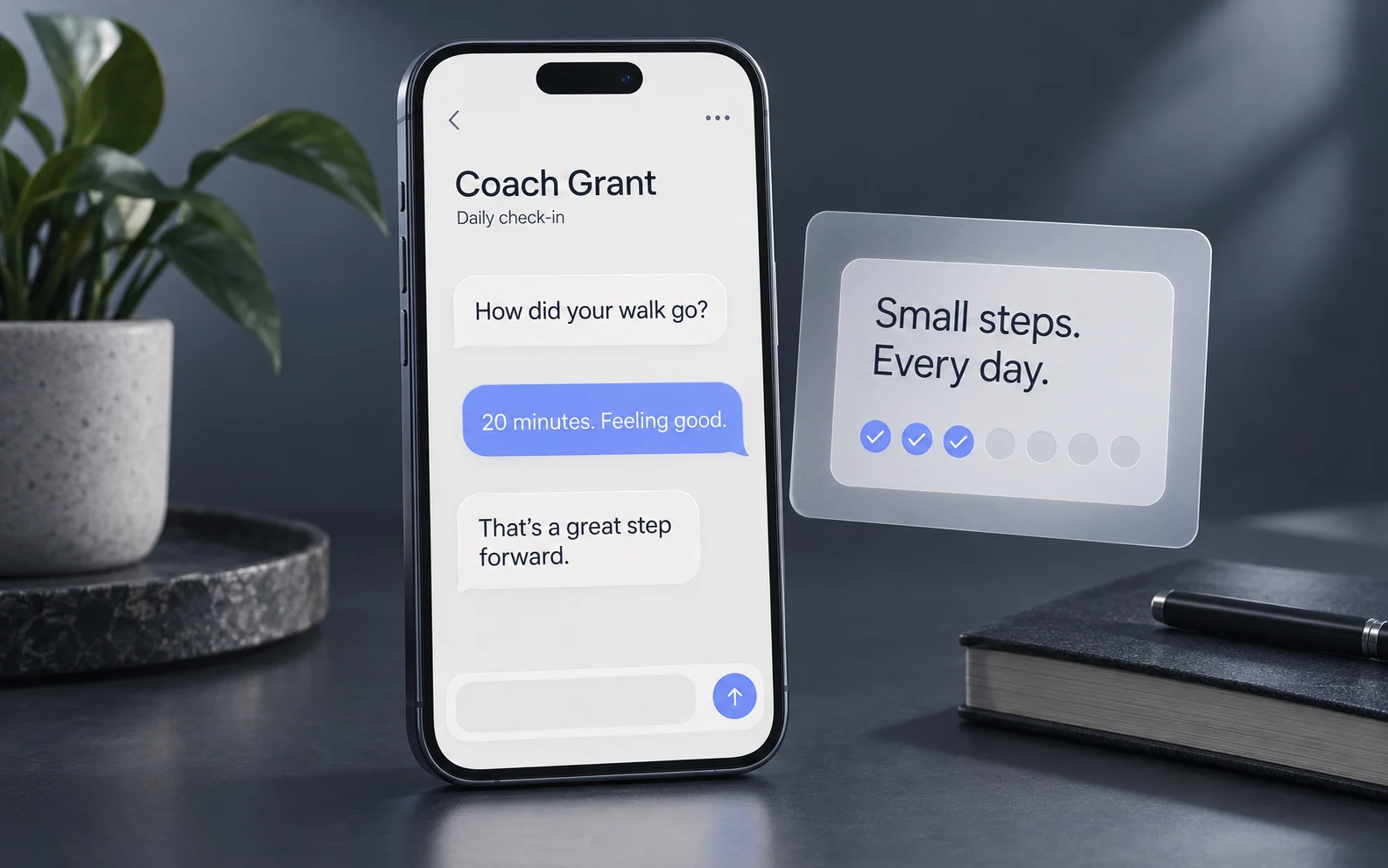
Coach Grant illustrative coaching concept
Illustrative coaching concept · fictional messages.
All products

Coach Grant

Coach Grant: For coaches supporting members between sessions

  • Member
  • Quiz
  • Coach
  • Authorized program staff
  • Coaching assistant
  • Assistant
  • Authorized owner

Between-session habit coaching that connects enrollment, an agreed goal, scheduled conversations and adaptive support to a coach’s view of each member’s progress.

Member consent and coach activation govern the program. Staff can pause or take over.

The workflow

Follow every branch. Select a heading to trace its connections.

Join the coaching program → Choose a habit and baseline (Consented and activated); Choose a habit and baseline → Agree the goal and next task; Agree the goal and next task → Agree the goal and next task (Choose an easier or harder option); Agree the goal and next task → Scheduled check-ins and reminders (Task accepted); Scheduled check-ins and reminders → Understand the member’s reply; Understand the member’s reply → Support barriers and questions (Barrier or question); Support barriers and questions → Agree the goal and next task (Proposed adaptation); Support barriers and questions → Scheduled check-ins and reminders (Current task explained); Understand the member’s reply → Reflect and review readiness (Progress evidence); Reflect and review readiness → Scheduled check-ins and reminders (Continue current task); Reflect and review readiness → Next steps and maintenance (Ready for next step or maintenance); Next steps and maintenance → Agree the goal and next task (Next task needs acceptance); Next steps and maintenance → Scheduled check-ins and reminders (Maintenance check-in); Understand the member’s reply → Corrections and preferences (Correction or preference); Corrections and preferences → Reflect and review readiness (Updated evidence); Understand the member’s reply → Pause, consent and safety (Pause, STOP or safety signal); Scheduled check-ins and reminders → Pause, consent and safety (Delivery or saved action uncertain); Pause, consent and safety → Coach supervision and program controls (Staff attention); Understand the member’s reply → Coach supervision and program controls (Conversation and decisions visible); Reflect and review readiness → Coach supervision and program controls (Progress visible); Coach supervision and program controls → Choose a habit and baseline (Human replan); Coach supervision and program controls → Scheduled check-ins and reminders (Resume only with valid consent); Coach supervision and program controls → Agree the goal and next task (Approved program content); A personal starting routine from the quiz → Join the coaching program (Member continues enrollment); A personal starting routine from the quiz → Choose a habit and baseline (Chosen starting habit); Pause, consent and safety → Manual coaching and attention (Needs attention); Coach supervision and program controls → Manual coaching and attention (Coach intervenes); Manual coaching and attention → Agree the goal and next task (Reviewed plan or track change); Manual coaching and attention → Scheduled check-ins and reminders (Release takeover or stage hold); Author and review the coaching program → Agree the goal and next task (Authored tasks and rules); Author and review the coaching program → Coach supervision and program controls (Program information visible).

  1. Member and quiz

    1. Answer questions about goals, current habits and starting ability.
    2. Choose an initial habit and share its relevant baseline.
    3. See a suggested morning, daytime and evening routine.
    4. Carry the chosen starting habit into enrollment and coaching.

    The quiz provides a concrete starting point rather than only collecting contact details.

    • Member continues enrollment
    • Chosen starting habit
  2. Member and coach

    1. Complete the signup or quiz and share program context.
    2. Give the required communication consent.
    3. Have the coach activate enrollment when the member is ready.

    Joining, permission to contact and active coaching are separate steps.

    • Consented and activated
  3. Member and coach

    1. Choose the habit the member wants help with.
    2. Record a starting baseline.
    3. Use the program’s authored habits and approved content.

    Coaching starts from a specific habit and a known starting point.

  4. Authorized program staff

    1. Maintain program tracks and their stage content.
    2. Manage approved product and provider information within the staff role.
    3. Preview and review proposed coaching-rule changes.
    4. Apply approved content changes for future coaching.

    Program content is an authored, reviewed part of the service rather than an unrestricted assistant invention.

    • Authored tasks and rules
    • Program information visible
  5. Member and coaching assistant

    1. Propose a goal, task and cue.
    2. Let the member accept or ask for an easier or harder option.
    3. Save the accepted task as the active assignment.

    A proposed task becomes an assignment only after acceptance.

    • Choose an easier or harder option
    • Task accepted
  6. Coaching assistant

    1. Teach the current approved task.
    2. Send the check-in at the member’s configured time and cadence.
    3. Keep the conversation focused on the current assignment.

    The schedule supports the agreed habit and can change as the member progresses.

    • Delivery or saved action uncertain
  7. Member, assistant and coach

    1. Respect STOP, revoked consent, pause and human takeover.
    2. Use the approved safety response when a safety signal appears.
    3. Hold the affected automated coaching and alert staff.
    4. Do not invent progress when delivery or a saved action is uncertain.

    Permission and safety take priority over the ordinary coaching loop.

    • Staff attention
    • Needs attention
  8. Coaching assistant and member

    1. Ask about a barrier when the member struggles.
    2. Offer an approved easier task or adaptation.
    3. Explain how or why to do the current task.
    4. Confirm a proposed change with the member.

    Support can adjust without inventing a new task or changing the plan behind the member’s back.

    • Proposed adaptation
    • Current task explained
  9. Member and coaching assistant

    1. Listen for completion, partial progress, missed work or difficulty.
    2. Recognize questions, corrections and preference changes.
    3. Record what the reply actually supports.

    A reply is evidence for the next coaching step, not automatic proof of progress.

    • Barrier or question
    • Progress evidence
    • Correction or preference
    • Pause, STOP or safety signal
    • Conversation and decisions visible
  10. Member and coach

    1. Correct recorded answers when the member clarifies them.
    2. Apply valid timing, cue or easier-task requests.
    3. Keep the updated record visible to staff.
    4. Let authorized staff correct a member’s displayed name, timezone or unsupported remembered detail.

    Members can clarify what happened and ask for practical changes.

    • Updated evidence
  11. Member and coaching assistant

    1. Ask scheduled reflection or challenge-review questions.
    2. Check completion, consistency and how manageable the task feels.
    3. Continue the current assignment when the member is not ready to advance.

    Progression follows recorded evidence and the member’s response.

    • Continue current task
    • Ready for next step or maintenance
    • Progress visible
  12. Coach

    1. Find members or flags that need attention.
    2. Send a manual message when a personal reply is needed.
    3. Mark an excused check-in or hold a stage when appropriate.
    4. Start a track, take over a conversation or hand it back to automated support.

    The coach has direct operational controls for exceptions and personal support.

    • Reviewed plan or track change
    • Release takeover or stage hold
  13. Member and coaching assistant

    1. Propose the next authored task or habit when ready.
    2. Get acceptance before assigning it.
    3. Keep mastered habits in maintenance.
    4. Taper check-ins and make periodic follow-up checks.

    The loop can progress, stay steady or reduce its cadence as appropriate.

    • Next task needs acceptance
    • Maintenance check-in
  14. Coach and authorized owner

    1. See members, messages, decisions, consent and progress.
    2. Take over, pause or replan a member’s support.
    3. Manage authored program tracks and approved provider or product information within the relevant staff role.
    4. Inspect quiz results and program metrics to understand enrollment and engagement.

    The coach can oversee the conversation and intervene when needed.

    • Human replan
    • Resume only with valid consent
    • Approved program content
    • Coach intervenes

The result

Ongoing, agreed habit support between sessions, with evidence-based progression and a coach able to intervene.

What to know

An AI health coach that supports members day to day through conversations, habit check-ins and follow-ups.

Member consent comes first. Staff can pause or take over, and safety cases are escalated. This is not a medical outcome claim.

The coaching cadence can taper as a member settles into the routine.